The Orthodox Icon of the Resurrection (Anastasis)

The Orthodox Icon of the Resurrection (Anastasis)

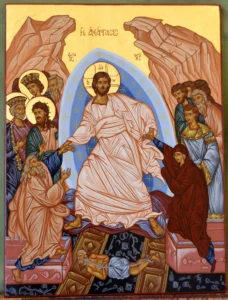
In the Orthodox Church, the icon of the Resurrection is not usually a picture of Christ coming out of the tomb. Instead, it depicts the Descent into Hades, called the Anastasis (Ἀνάστασις), meaning Resurrection.

This icon is actually a visual sermon expressing the theology taught by the Fathers and proclaimed in the services of Pascha.

Every detail in the icon carries deep meaning.


1. Christ Standing on the Broken Gates of Hades

At the center stands Christ in radiant light. Beneath His feet are the shattered gates of Hades, often arranged in the shape of a cross.

You can also see:

  • broken locks
  • chains
  • keys scattered around.

This imagery comes from Scripture:

“Lift up your heads, O gates… that the King of Glory may enter.”
— Psalm 24:7

The Fathers interpret this as Christ breaking the prison of death.

John Chrysostom famously proclaimed in his Paschal sermon:

“Hell was embittered when it encountered Thee…
It took a body and discovered God.”

Death thought it imprisoned a man—but instead its gates were shattered.


2. Christ Pulling Adam from the Tomb

One of the most striking features is that Christ does not simply hold Adam’s hand. Instead He grabs Adam by the wrist and pulls him out of the grave.

This detail is very important.

It shows that salvation is not something humanity accomplishes on its own. Humanity is dead and powerless, and Christ raises it by His power.

Gregory of Nyssa explains that Christ came to rescue the whole human race through Adam, since Adam represents all humanity.

Thus Adam symbolizes every human being.


3. Eve Following Adam

Adam and Eve in the Anastasis Icon

In the icon of the Resurrection (the Anastasis), both Adam and Eve represent the whole of fallen humanity that is now being restored by Christ.

They do not symbolize two different states (one fallen and one restored). Instead, both together represent the human race.

The theological meaning is:

  • Adam and Eve together = humanity in its fall
  • Adam and Eve together = humanity raised by Christ

Why Both Are Present

The Fathers often speak of Adam as the head of humanity, because through him the fall entered the world (Romans 5:12). But they also consistently emphasize that salvation restores all human nature, male and female.

For this reason, the icon includes both Adam and Eve, showing that Christ redeems the entire human family.

Gregory of Nyssa writes:

“In the resurrection the whole of human nature is restored.”
On the Making of Man, 21

Thus the icon depicts the restoration of human nature itself, not just individual persons.


Why Christ Grabs Adam First

In most icons Christ pulls Adam first by the wrist. This does not mean Adam represents only fallen humanity while Eve represents restored humanity.

Rather, Adam appears first because:

  1. Adam is the biblical head of humanity (Romans 5).
  2. The fall is described as entering through Adam.
  3. Christ is called the “New Adam.”

Athanasius of Alexandria explains:

“The Word took a body from the race of Adam in order to renew it.”
On the Incarnation, 8

So Adam’s position in the icon reflects the restoration of the entire human nature Christ assumed.


Eve’s Gesture

Eve is often shown:

  • bowing
  • covering her hands in reverence
  • being lifted after Adam.

This reflects humility and repentance, but she still represents humanity as a whole being raised from death, not a different theological category.

Irenaeus of Lyons famously wrote:

“As through a man death gained victory, so through a man victory over death was obtained.”
Against Heresies, V.19.1

The resurrection therefore restores the entire human race descended from Adam and Eve.

The fall that began in Genesis is now reversed.

Irenaeus of Lyons wrote:

“The knot of Eve’s disobedience was loosed by the obedience of Christ.”
Against Heresies, Book III, 22

Thus the icon shows the healing of human nature itself.


4. The Righteous of the Old Testament

Around Christ stand many figures from the Old Testament.

Often included are:

  • King David
  • Solomon
  • John the Baptist
  • the prophets.

John the Baptist is sometimes shown pointing toward Christ because he had already preached to those in Hades that the Messiah was coming.

This reflects the teaching that Christ’s descent liberated the righteous who awaited salvation.


5. The Mandorla (Divine Light)

Christ is surrounded by a deep blue oval called a mandorla, representing uncreated divine light.

The darker blue toward the center symbolizes something profound:

The closer one comes to God, the more His mystery becomes beyond human comprehension.

Gregory Palamas later explained that the saints experience God’s uncreated energies, the same divine light seen in Christ’s Transfiguration.

Thus the Resurrection is not merely a historical event—it is a revelation of divine glory.


6. The Dark Abyss Beneath Christ

At the very bottom of the icon there is often a dark cave or abyss.

Sometimes a bound figure lies there, representing Death or Satan.

This shows that Christ has not merely escaped death—
He has defeated it completely.

As Scripture says:

“O Death, where is your sting?
O Hades, where is your victory?”
— 1 Corinthians 15:55


7. The Spiritual Message of the Icon

The icon teaches something deeply personal.

Christ is not only raising Adam and Eve.

He is raising every human person.

Athanasius of Alexandria wrote:

“The Word became man so that we might become divine by grace.”
On the Incarnation, 54

The Resurrection is therefore the restoration of human nature itself.


8. A Beautiful Insight from the Fathers

A desert elder once said:

“If Christ had not descended to the lowest depths, even the lowest sinner would think salvation impossible.”

But because Christ entered the deepest darkness of death, no place remains outside His reach.

Even the grave becomes the doorway to life.


☦️ This is why the Orthodox Church sings at Pascha:

“Christ is risen from the dead,
trampling down death by death,
and upon those in the tombs bestowing life.”

The icon of the Anastasis shows this hymn in visual form.

The Broken Gates Beneath Christ’s Feet

One of the most profound details in the Orthodox Anastasis icon is what lies beneath Christ’s feet: the broken gates of Hades.

At first glance they appear simply as shattered wooden boards, locks, chains, and keys scattered beneath Him. But the Fathers and iconographers intentionally arrange them so that the two main beams form the shape of a cross.

This detail carries deep theological meaning.


1. The Cross Has Become the Weapon Against Death

In the icon, Christ stands on the broken gates of death.

This visually proclaims the truth that the Cross itself shattered Hades.

What once seemed like the instrument of defeat becomes the instrument of victory.

John Chrysostom proclaims in the Paschal homily:

“It took a body and met God face to face.
It took earth and encountered heaven.”
Paschal Homily

Death believed it was conquering Christ on the Cross. Instead, the Cross became the key that broke the prison of death.


2. The Locks, Keys, and Chains

You often see:

  • locks
  • keys
  • chains
  • nails

scattered around the gates.

These symbolize the power of death and sin that held humanity captive since the fall of Adam.

The imagery echoes Christ’s words in the Gospel:

“I have the keys of Death and Hades.”
— Revelation 1:18

Through His death, Christ breaks the locks that imprison humanity.

Gregory of Nyssa used a striking image to explain this:

“The divinity was hidden under the veil of flesh like a hook hidden in bait.”
Great Catechism, 24

Death swallowed the “bait” of Christ’s humanity—
but encountered the divine power that destroyed it from within.


3. Why the Gates Are Under Christ’s Feet

The icon deliberately shows Christ standing on the gates, not merely breaking them.

This represents total victory.

Psalm 110 prophesies this imagery:

“Sit at My right hand until I make Your enemies Your footstool.”

Death itself becomes the footstool of Christ.

The Cross therefore becomes the throne of victory.


4. The Darkness Beneath the Gates

Below the shattered gates is often a dark abyss, sometimes with a bound figure representing Satan or Death.

This reflects the teaching of the Fathers that Christ’s descent into Hades emptied its power.

Athanasius of Alexandria writes:

“By His death He destroyed death.”
On the Incarnation, 27

This paradox is central to Orthodox theology:

Christ defeats death by entering death.


5. The Hidden Message of the Icon

The broken gates arranged in the form of a cross reveal something very beautiful:

The Cross is not simply the place where Christ died.

It is the door through which humanity leaves the prison of death.

This is why the Church sings during Pascha:

“Christ is risen from the dead, trampling down death by death.”

The icon literally depicts Christ trampling death.


6. A Story from the Desert Fathers

An elder once explained the Resurrection with a simple image.

He said:

“Imagine a king who sees his people imprisoned in a dungeon. He does not merely break the lock from outside. He enters the prison, shatters the doors from within, and leads the captives out.”

This is exactly how the Fathers describe Christ’s victory.

Isaac the Syrian wrote:

“Love could not bear to see mankind tormented by death.”
Ascetical Homilies, 81

So Christ entered the prison of death Himself to free humanity.


7. The Personal Meaning of This Image

The Anastasis icon is not only about Adam and Eve.

Every person has their own “gates of Hades”:

  • sin
  • fear
  • despair
  • death.

The icon shows that Christ stands over every prison that holds humanity captive.

And just as He grasps Adam by the wrist and pulls him from the tomb, He also raises every person who reaches toward Him.


☦️ In the end, the icon teaches the whole Gospel in one image:

  • The Cross breaks death
  • Christ destroys Hades
  • Humanity is lifted from the grave
  • The Resurrection becomes the beginning of the new creation

Why Christ’s Robes Move Like Light in the Anastasis Icon

In many Orthodox icons of the Anastasis (Resurrection), Christ’s garments appear dynamic and flowing, almost as if they are moving in a powerful wind or explosion of light. This is not simply an artistic choice. It is a deliberate theological symbol rooted in Scripture and the teachings of the Fathers.


1. The Garments Represent Divine Glory

Christ’s robes in the Resurrection icon often appear brilliant white or golden, flowing outward in radiant movement.

This imagery recalls the Transfiguration of Christ on Mount Tabor.

The Gospel says:

“His garments became shining, exceedingly white like snow.”
— Matthew 17:2

The Fathers interpret this as the revelation of the divine glory hidden in Christ’s humanity.

Gregory Palamas explains that the light of the Transfiguration is the uncreated light of God, the same divine glory that shines forth in the Resurrection.

Thus the moving robes represent divine energy bursting forth from Christ.


2. The Motion Shows the Power of the Resurrection

Icons often depict Christ’s garments as if they are swept upward or outward.

This movement visually expresses the power of the Resurrection.

Christ is not merely standing quietly—He is entering Hades with overwhelming divine authority.

John of Damascus writes:

“The light of the divinity shone through the body even in the tomb.”
Exact Exposition of the Orthodox Faith, Book III

Therefore the Resurrection is not simply Christ returning to life. It is the manifestation of divine glory through His human nature.


3. The Wind of the New Creation

The flowing robes also symbolize the breath or movement of the Holy Spirit.

In Scripture, the word for spirit and breath is:

πνεῦμα (pneuma) — meaning spirit, breath, wind.

At the beginning of creation:

“The Spirit of God was moving over the face of the waters.”
— Genesis 1:2

The Resurrection represents the beginning of a new creation.

Maximus the Confessor teaches:

“The Resurrection is the renewal of human nature and the beginning of the new creation.”
Ambigua, 42

Thus the movement in Christ’s robes symbolizes the life-giving power of God renewing the world.


4. Christ Pulling Humanity into Motion

Notice that while Christ’s robes move with powerful energy, Adam and Eve are often shown being pulled upward by Him.

This reveals another theological truth:

Humanity does not rise by its own power.
Christ lifts humanity into the movement of divine life.

Athanasius of Alexandria explains:

“The Word became man so that we might become god by grace.”
On the Incarnation, 54

The flowing garments visually show that divine life is overflowing into humanity.


5. The Light That Enters the Darkness

Another important detail is the contrast between:

  • the radiant light around Christ
  • the dark abyss of Hades beneath Him

This illustrates the prophecy:

“The people who sat in darkness have seen a great light.”
— Matthew 4:16

Christ’s radiant robes symbolize light entering the deepest darkness of death.


6. A Story from the Saints

There is a story from the life of Seraphim of Sarov.

During a famous conversation with Nicholas Motovilov, witnesses described how the saint’s face and clothing shone with an extraordinary light.

St. Seraphim explained that this light was the grace of the Holy Spirit, the same divine glory revealed in Christ.

The Resurrection icon reflects this same truth:
Christ’s divine glory radiates outward and transforms humanity.


7. The Spiritual Meaning

The flowing robes remind us that the Resurrection is not only about Christ—it is about our transformation.

Through Christ’s victory:

  • death loses its power
  • humanity receives divine life
  • the entire creation begins to be renewed.

As the Church sings at Pascha:

“Now all things are filled with light:
heaven and earth and the depths beneath the earth.”


☦️ The Anastasis icon therefore shows three movements at once:

  • Christ descending into Hades
  • Christ lifting humanity upward
  • divine glory bursting into creation

It is the entire Gospel painted in one image.

On Key

Related Posts

Reading Scripture in an Orthodox way

Reading Scripture in an Orthodox way: 1. Doctrinal Explanation The patristic method of reading Scripture is not merely intellectual or academic—it is a participation in