
The Gospel of the Genealogy of Jesus and the Holy Fear of Joseph
On the Sunday before Christmas, the Church proclaims during the Divine Liturgy the Gospel according to Matthew (1:1–25). This Gospel passage has never ceased to open my eyes to ever-deeper wisdom. It reveals how the Holy Spirit guided the Evangelist Matthew to choose and arrange these names with remarkable precision. To the attentive reader and listener, this genealogy is far more than a list of names; it is a profound theological proclamation.
Matthew opens his Gospel with two striking words: βίβλος γενέσεως (biblos geneseōs). The first word, biblos, points directly to the Scriptures, while the second, genesis, deliberately recalls the first book of the Bible. With this opening, Matthew proclaims that just as the first creation had its Genesis, so too does Jesus Christ. All creation has its book of Genesis, and now, Christ has his own Genesis.
The opening sentence continues: “Jesus Christ, the Son of David, the Son of Abraham.” Why does Matthew summarize the entire genealogy with only these two names? Because Jesus is the fulfillment of the two foundational promises of the Old Testament. To Abraham, God promised: “In your seed all the nations of the earth shall be blessed” (Genesis 22:18). To David, He swore: “Of the fruit of your body I will set upon your throne” (Psalm 132:11). These two promises converge and are fulfilled in one Person—Jesus Christ. David is mentioned before Abraham, not chronologically, but because of the royal dignity of kingship.
As Matthew unfolds the genealogy, we encounter four women—yet notably, not the great matriarchs of Israel such as Sarah, Rebekah, or Rachel. Instead, Matthew includes women marked by scandal, marginalization, or foreign origin. Tamar disguised herself as a harlot and conceived by her father-in-law (Genesis 38). Rahab was a Canaanite prostitute who nonetheless entered the people of Israel (Joshua 2). Bathsheba is not even named, but is referred to as “the wife of Uriah,” a painful reminder of David’s adultery and the arranged death of her husband (2 Samuel 11).
By including these women, Matthew teaches us that Christ’s ancestry offers Him nothing to boast of according to human standards. Instead, He willingly enters into the depths of human brokenness. He assumes the shame of His ancestors in order to heal it. Christ takes upon Himself the sins of His lineage, not to inherit corruption, but to cleanse it by His very birth.
It is not Abraham or David who honor Christ; rather, Christ honors them by fulfilling God’s promises to them—despite their sins and the sins of their descendants.
Alongside these figures stand two women of faith. Ruth, a Moabite who joined Israel through marriage, remained faithful to the God of Israel. Saint John Chrysostom sees her as a figure of the Church drawn from the nations—those who come to Christ and remain steadfast in faith. Finally, there is Mary, the Mother of Jesus: daughter of Israel, and the perfect model of obedience and faith for all believers.
The four women together symbolize the four corners of the earth, embracing all nations within the mystery of salvation.
One detail in the genealogy may appear puzzling: “Judah begat Pharez and Zarah of Tamar; and Pharez begat Hezron.” Zarah plays no role in the lineage—so why is he mentioned at all? The story in Genesis recounts that during Tamar’s labor, Zarah extended his hand first, and a scarlet thread was tied around it to mark him as the firstborn. Yet he withdrew his hand, and his brother Pharez emerged first, taking the place of primacy (Genesis 38:27–30).
Saint John Chrysostom explains that Matthew traces Christ’s lineage through Pharez because Pharez represents the Church drawn from the Gentiles. Though Israel appeared first as God’s chosen people, many refused Christ and lost their primacy. The nations, uniting themselves to Christ—the true Firstborn—became heirs of the promise. Zarah reached out first but did not emerge; Pharez broke through and took his place. What seemed secondary became first through union with Christ.
This same pattern recurs throughout salvation history: Old Adam and the New Adam; Ishmael, the son born according to the flesh, and Isaac, the son of the promise from Sarah’s barren womb; the synagogue and the Church; the old king and the new King.
Matthew then highlights the numerical structure of the genealogy: fourteen generations from Abraham to David, fourteen from David to the Babylonian exile, and fourteen from the exile to Christ. Three sets of fourteen—3 × 14 = 3 × 2 × 7 = 6 × 7. Six times seven suggests incompletion. With the coming of Christ, the final seven times seven is fulfilled—the fullness of time has arrived.
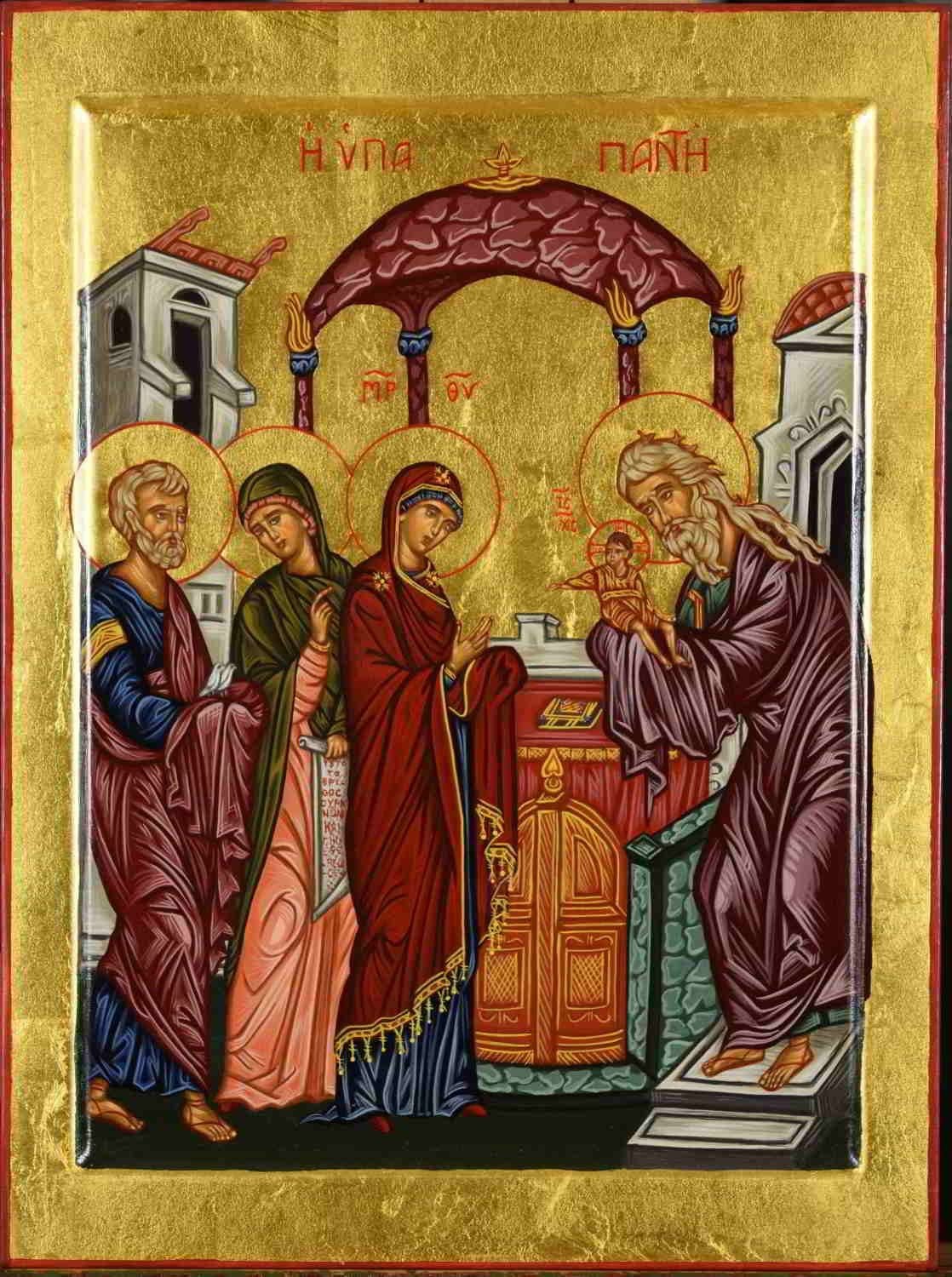
The genealogy concludes with a striking and unusual formulation: “Jacob begat Joseph, the husband of Mary, of whom was born Jesus, who is called Christ.” The genealogy ends with Joseph, though he is not the biological father of Jesus—a tension resolved only by the angelic revelation.
The phrasing itself breaks every convention. A man is never defined by his wife; the usual expression would be “Mary, the wife of Joseph.” Here, Joseph—and with him all his ancestors—appears diminished before the majesty of Mary.
Even more striking is the second clause. Matthew does not say that Mary gave birth to Jesus, but that Jesus was born of Mary. The grammatical emphasis falls on the Child, not the mother. This points to a birth beyond the ordinary laws of nature—one accomplished not through human effort or pain, – the painful labor of a woman -, but by divine power and will. It recalls Isaiah’s prophecy: “Before she was in labor, she gave birth; before her pain came, she delivered a male child” (Isaiah 66:7).
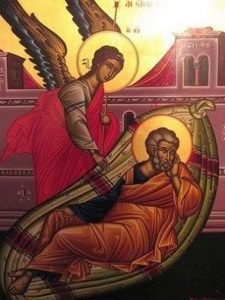
Another profound tension arises in Joseph’s response to Mary’s pregnancy. Joseph is described as a just man—one faithful to the Law. According to the Law, such a situation could require public accusation and even death by stoning. Yet Joseph chooses a different path: “not wishing to make her a public example, he resolved to put her away quietly.” In doing so, he appears to act against the Law and thus risks losing his status as a just man. This paradox can be resolved only through angelic revelation.
The angel addresses both issues with a single command: “Joseph, son of David, do not fear to take Mary as your wife.” By calling him son of David—rather than son of Jacob as it appears in the genealogy above—the angel assigns Joseph a decisive role: to receive the Child as his own and to name Him. In Jewish tradition, naming a child by his father establishes legal fatherhood. By naming Jesus, Joseph legally places Him within the house of David.
The command “do not fear” reveals Joseph’s true struggle. His hesitation did not arise from suspicion, but from holy fear. Joseph perceived that God Himself was at work in Mary, and in humility he sought to withdraw. Throughout Scripture, both Old and New Testament, the direct presence of God inspires fear and awe. Joseph feared standing too close to such divine mystery.
Notably, the angel does not argue about the Law of Moses. He addresses only Joseph’s fear. He commands him to name the Child Jesus, “for He will save His people from their sins.” This is immediately linked to Isaiah’s prophecy: “They shall call His name Emmanuel,” meaning “God with us.” In the Incarnation, God truly dwells among His people.
Seen in this light, the phrase “he knew her not until she had brought forth her firstborn son” is best understood not through grammatical debate, but through Joseph’s reverence and fear. Who has ever heard of a queen belonging to another after her union with the King—even after His death? How could the Bride of the Heavenly King belong to another while He remains eternally present? Such thoughts inspire holy fear.
Moreover, Scripture itself uses the word “until” without implying a change afterward:
- “Our eyes wait upon the Lord our God, until He has mercy upon us” (Psalm 123:2).
- “Sit at My right hand, until I make Your enemies Your footstool” (Psalm 110:1).
- “His heart is established; he shall not be afraid, until he sees his desire upon his enemies” (Psalm 112:8).
In none of these cases does “until” imply a reversal afterward.
One can scarcely imagine Joseph’s relationship with Mary after the angel confirmed that what was conceived in her was of the Holy Spirit.
In the Third Hour of the Royal Hours of the Nativity, the Church poetically expresses this mystery. Joseph searches the Scriptures and is then instructed by the angel to receive the Divine Child:
“I have searched the prophets,” he says,
“and I have been instructed by an angel.
I am convinced that Mary will give birth to God
in a manner beyond understanding.”
Thus, Joseph becomes not merely a guardian, but a reverent witness to the mystery of God made flesh.
Rev. Father Mansour Azar
Reference: Royal Hours of the Nativity, Third Hour, Tone 3.